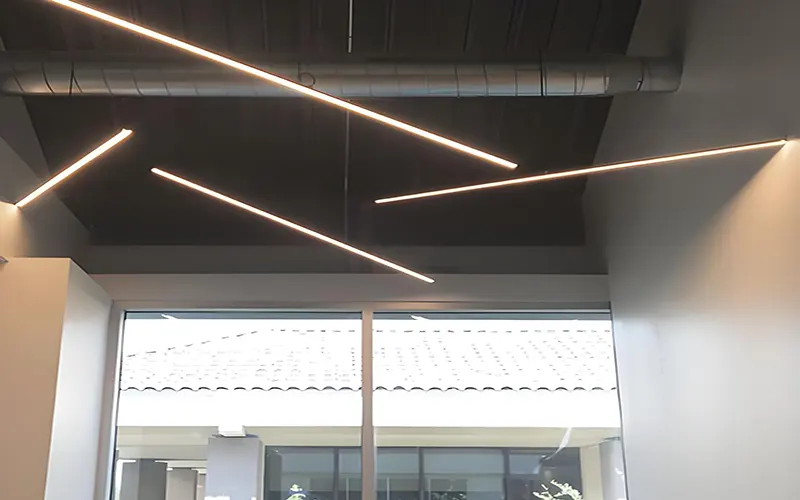
In commercial buildings, public spaces, and high-end residential projects, staircase decoration is receiving increasing attention, recognizing it not only as a functional structure but also as a crucial component influencing overall safety and visual appeal. Balancing functionality, safety, and design aesthetics remains a continuous challenge for project developers, architects, and lighting engineers. Traditional stair nosing primarily focuses on slip resistance and edge protection, but with the rapid advancements in lighting technology, a revolutionary solution has emerged: LED stair nosing profiles.
LED stair nosing profiles combine structural protection and integrated lighting in an innovative way, becoming a key component for enhancing the safety standards and design sophistication of commercial real estate. Pls see Why Use a LED Stair-Tread Aluminum Profile?
What is an LED Stair Nosing Profile?
An LED stair tread trim strip is a profile component specifically installed on the edge of stair treads. Its core design comprises two main functional modules: First, as a “trimming strip,” it protects and finishes the edge of the stair flooring material. It also provides a high-strength, non-slip surface and ensures the tread edges are clearly visible. This meets the stringent safety requirements of numerous global building safety codes (such as the US ADA and the UK DDA).
Second, as a “lighting carrier,” it integrates a high-efficiency, long-life LED light strip within the profile, creating continuous and uniform guiding light along the tread edges. Therefore, it is essentially an integrated system of safety, structure, and lighting.
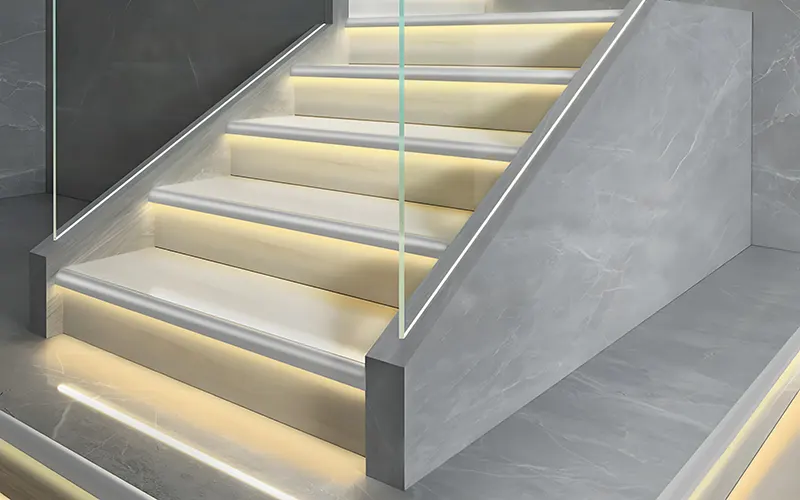
Core Functions and Advantages of LED Stair Nosing Profile
- Enhancing Staircase Safety: Clearly marked tread edges reduce safety hazards at night or in emergencies.
- Anti-slip and Protective: The metal body and anti-slip structure effectively protect the tread edges.
- Lighting and Guiding Function: Provides supplementary lighting to improve overall spatial visibility.
- Aesthetics and Modernity: Linear lighting enhances the staircase’s design.
- Compliance with Engineering Standards: Easier to pass safety inspections in commercial and public buildings.
What are the Structure and Materials of LED Stair Nosing Profile?
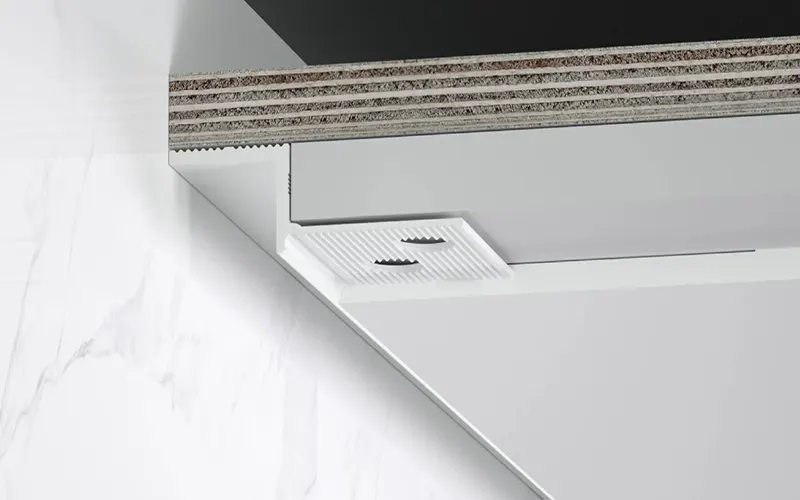
Actually, it’s also an LED profile, including related accessories. A high-quality LED trim strip’s performance is based on its physical structure, mainly composed of the following parts:
LED Profile Body
Most commonly, extruded aluminum alloy is used due to its high strength, light weight, corrosion resistance, and ease of processing into complex shapes. The surface is usually anodized to form a hard, wear-resistant protective film.
A variety of colors are available (such as silver, black, bronze, champagne gold, etc.) to match design requirements. Stainless steel is also used for areas with extremely high wear.
Diffuser and Anti-slip Design
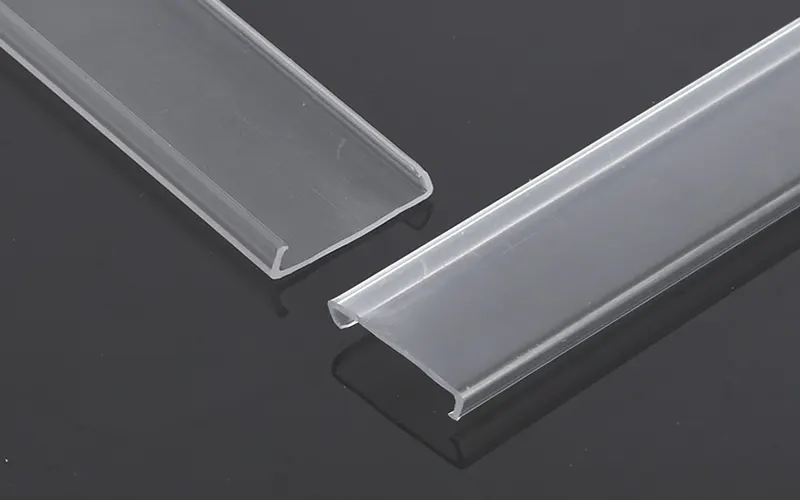
- PC Diffuser: Uniform light transmission, high impact resistance
- Anti-slip strip structure: Some models integrate anti-slip strips to improve step friction
- Integrated light trough and pedal design: Ensures a stable light strip and soft light
What are the Lighting Methods for LED Stair Nosing Profile?
The lighting effect is directly determined by the technical parameters and the direction of light emission, which is the core technology for project selection. Light emission direction: This determines the angle of light projection and the visual effect.
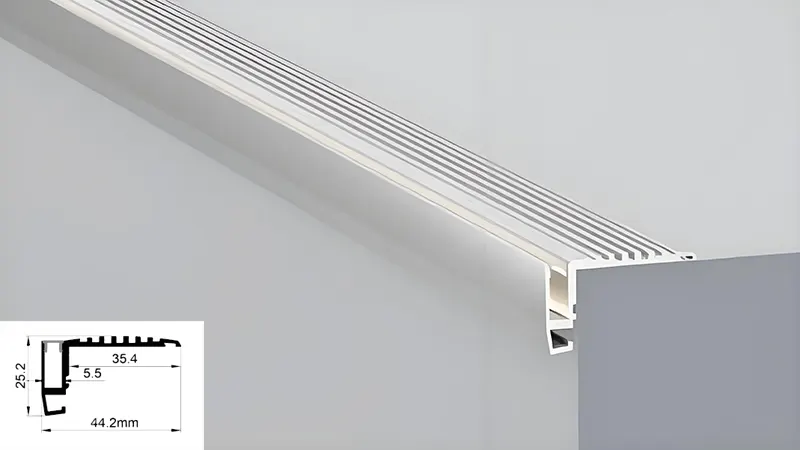
Top-lit (e.g., 4525 / 5528 / 66*28): Light primarily shines upwards, illuminating the staircase facade (rafters) to create a wash-out effect, emphasizing the layering and three-dimensionality of the steps. Smaller in size, it appears more refined.
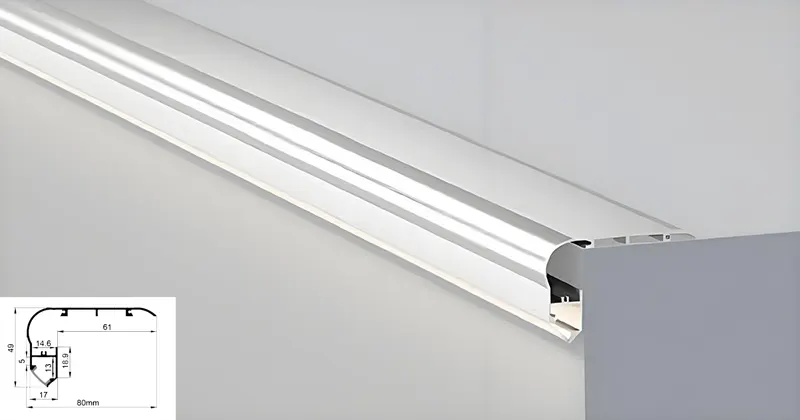
Bottom-lit (e.g., 5528 / 8050 / 82*57): Light primarily shines downwards, illuminating the surface of the next step (tread), providing clear ground lighting and enhancing safety. Typically larger in size, with higher luminous flux output.
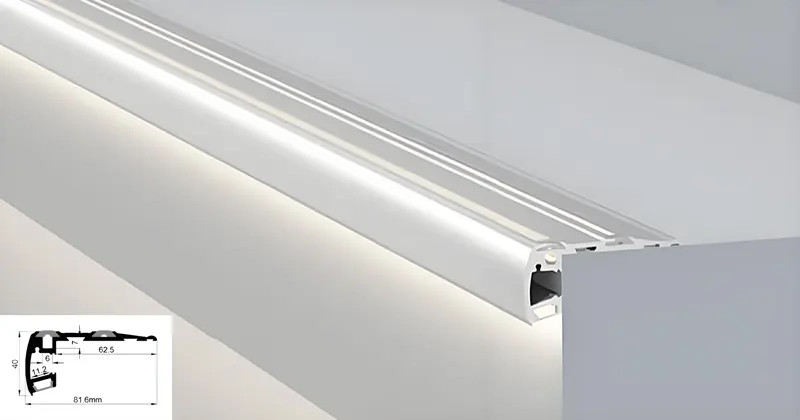
Two-way illuminated (e.g., 80*38): Combines both top and bottom illumination, providing the most comprehensive lighting coverage, resulting in a fuller visual experience. Suitable for locations with the highest overall brightness requirements.
How to Install LED Stair Nosing Profile?
Proper installation is crucial for product performance and lifespan. There are two common installation methods for LED stair tread edge strips. For more details, please read “How to Install LED Profiles for Stair Lighting?
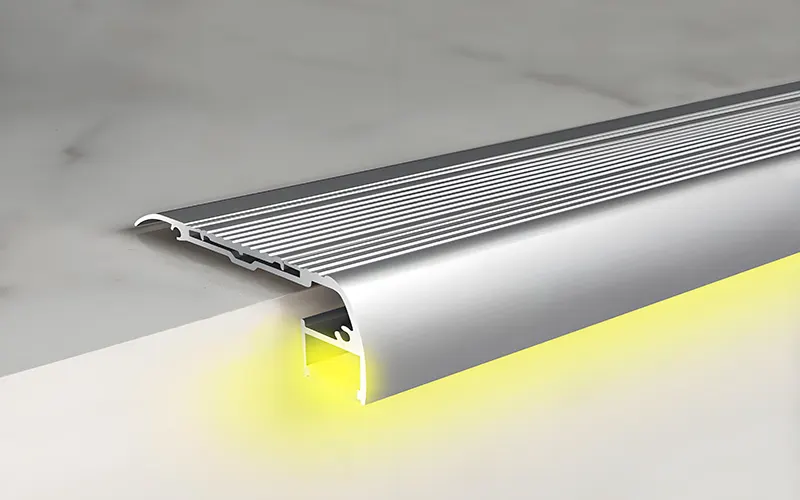
Recessed/Flush Mount
- Features: The profile is flush with the stair surface, providing the cleanest, most modern look.
- Suitable for: New construction or large-scale renovation projects requiring pre-installed mounting grooves in the stair structure.
- Advantages: Smooth surface, extremely low tripping risk.
Surface Mount
- Features: The profile is directly fixed to the edge of the existing staircase.
- Applications: Renovation or refurbishment projects for existing staircases.
- Advantages: Relatively simple and quick installation process, requiring no extensive modifications to the staircase structure.
Regardless of the method used, it is essential to ensure concealed wiring and professional power connections to meet electrical safety standards.
Common Issues in Procuring LED Stair Nosing Profile
In lighting projects, customers purchasing LED profiles typically focus on the following issues:
OEM/ODM customization support
Minimum Order Quantity (MOQ)
Sample testing availability
Delivery time and long-term supply stability
Compliance with local building and safety standards
Conclusion
LED stair nosing profiles are not only lighting products, but also indispensable safety and design elements in modern architecture. Through proper selection and professional installation, they can significantly enhance stair safety, project quality, and overall spatial value.
If you are looking for a reliable LED stair nosing profile solution for commercial or public projects, please contact us.
FAQs
Yes, planning the wiring is crucial for both safety and aesthetics. The placement of the power supply (driver) and concealed wiring routes (such as pre-buried conduits or utilizing the stair structure) need to be planned in advance during the stair structure construction phase or early in the renovation process.
Absolutely. Standard sizes are 1 meter, 2 meters, and 3 meters. The exterior color is silver. Customization is an important part of our services for large-scale projects. We can customize any length according to your staircase dimensions, avoiding the inconvenience and aesthetic issues of on-site cutting.
In engineering projects, LED stair tread trims are commonly powered by 12V or 24V low-voltage power supplies. This is safer than high-voltage solutions and makes it easier to comply with building and public safety regulations.
Yes. Most engineering-grade LED stair tread trim strips support customization of size, lighting direction (top/bottom/bidirectional), color temperature, and structure, making them ideal for project-based procurement needs.