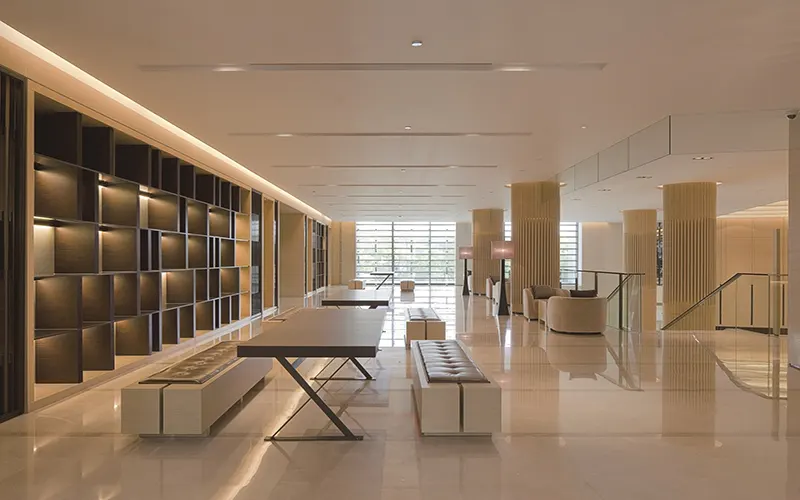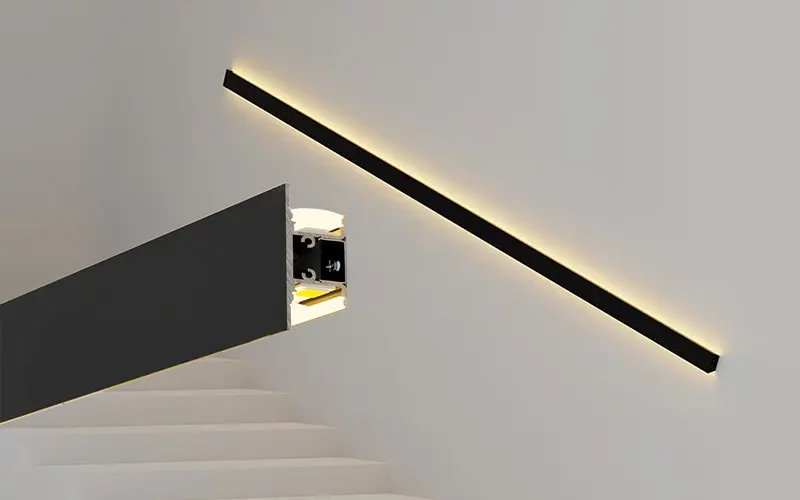
Suspended LED aluminum profile are ideal for decorative lighting; they can be found over modern kitchen islands, minimalist desks, and high-end retail display cases. Most lighting designers and users have likely encountered these suspended aluminum LED profiles.
Unlike recessed fixtures hidden in the ceiling or standard surface-mounted lights, these suspended profiles hang within the space, creating a floating visual effect. More details, pls check What are Suspended LED Profiles?
What Is a Suspended LED Aluminum Profile?
Suspended LED aluminum profiles (also known as LED suspension channels or extruded profiles) are specialized housings. As the name implies, they are designed to be suspended from the ceiling using accessories such as aircraft cables.
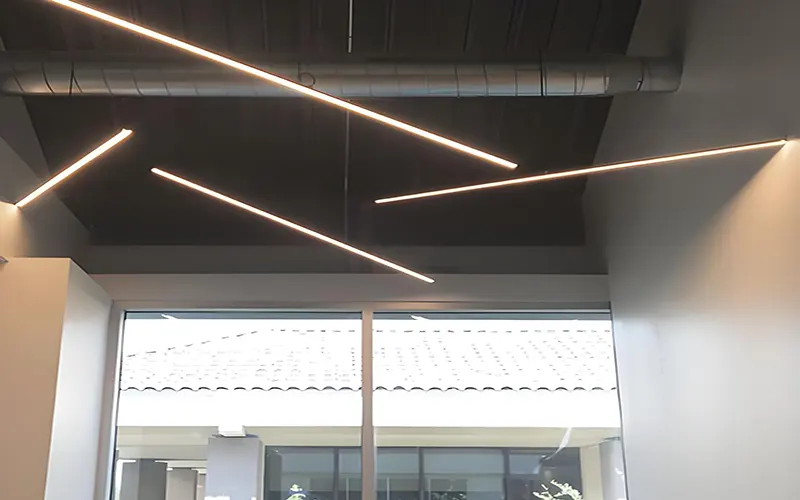
These LED profiles are engineered to house, protect, and dissipate heat for LED strips, while also emphasizing lighting versatility and aesthetic linear appeal.
Unlike profiles recessed into walls, suspended profiles are visible elements of the interior décor. They primarily serve three functions:
- Heat Dissipation: The suspended aluminum profile acts as a heat sink, drawing heat away from the LED chips and thereby extending their lifespan.
- Light Diffusion: With its built-in diffuser, the profile transforms harsh points of light into a soft, continuous glow.
- Structural Stability: It provides a rigid, straight housing that prevents the LED strip from sagging or detaching over time.
How Do you Choose Suspended LED Profiles Based on Lighting Aesthetics?
The shape of a suspended lighting profile defines the visual style of the entire space. While lighting performance is a key factor, the profile’s form plays a crucial role in the overall aesthetic. Here is an analysis of common shapes and their ideal applications:
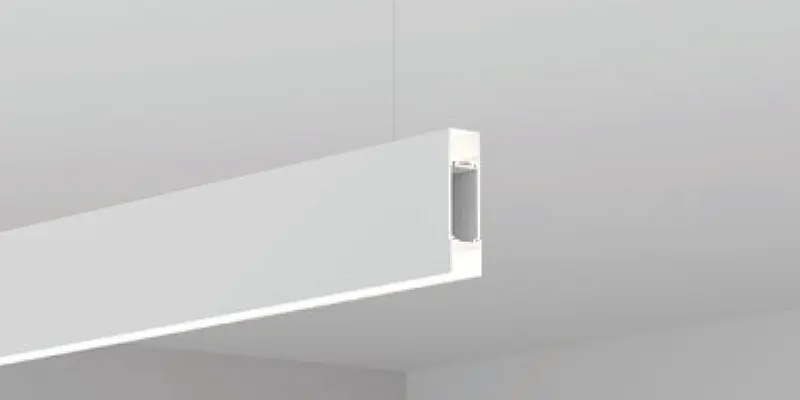
Ultra-slim Suspended LED Profiles (ES-2080)
Featuring a slender, sleek profile—typically only 20mm wide—these fixtures cast a remarkably fine line of light.
They are ideal for functional lighting in modern offices, minimalist retail displays, or as decorative light strips that trace the flow of a space. Understated yet elegant, they offer a refined aesthetic without being ostentatious.
Circular Profiles (ES-3030P / ES-3030H)
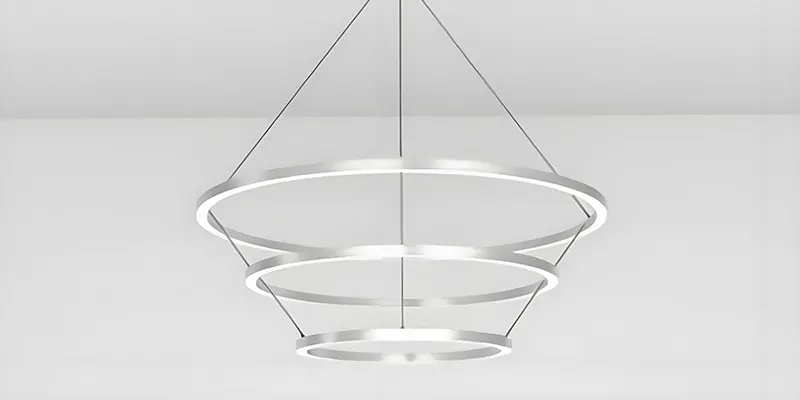
Circular extruded profiles are less common than rectangular ones, making them uniquely distinctive. Nevertheless, many lighting users opt for circular suspended LED profiles.
Ideal for: Modern art galleries, high-end restaurants, or as standalone cylindrical pendants suspended above round dining tables. They soften the rigid geometric lines often found in square or rectangular spaces.
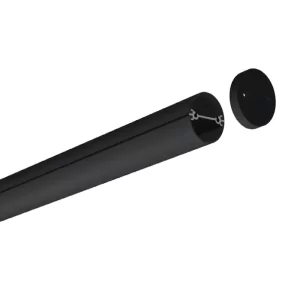
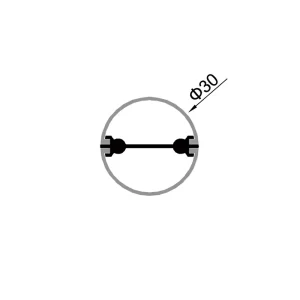
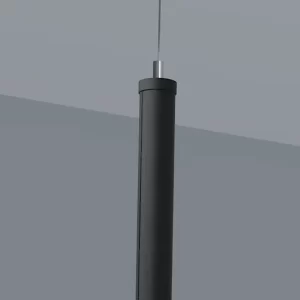


ES-3030H
| Material | Alu 6063-T5 |
| Surface treatment | Anodized/Painted |
| Diffuser material | PC |
| Apply To | Indoor application |
| MOQ | 100Meter/Item |
| Warranty | 3 years |
| Certification | CE,RoHS |
Product Features
Black Suspended LED tape aluminum profile model 3030H, the diameter of this LED profile is 30mm. It supports one-sided hanging or double-sided hanging, with LED strip lights emitting lights that are soft and even, and there are many installation methods to choose from.
Integrated Circular Profile (ES-3530 / ES-4025)
A large-diameter circular profile resembling an architectural-grade illuminated tube. Its spacious interior accommodates higher-wattage LED light sources.
Ideal for: Industrial-style lofts, museum art installations, or any space where the fixture itself is intended to serve as a sculptural focal point.
Standard Type (Rectangular/Square)
A classic, mainstay model in the industry, typically featuring a flat bottom and square-profile sides.
Applications: Task lighting for kitchen islands, office desks, and workbenches. They provide the most consistent illumination (broad, uniform diffused light) and are easily connected end-to-end to form continuous lines of light.
How Do you Choose the Right Size and Width for Suspended LED Aluminum Profile?
It primarily depends on the width and dimensions of your LED strips; you should consider the profile’s size and width based on those specifications.
Width: Internal Space (e.g., 8mm, 12mm, or 15mm)
The internal width must match the width of the LED strip. Common strip widths are 8mm, 10mm, and 12mm; you should allow for a clearance of 1–2mm. Additionally, wider profiles are suitable for multi-row strips or high-density LED strips (over 240 LEDs per meter). How to choose, pls check Understanding LED Profile Dimensions
Height: The Heat Dissipation Core
The height (or depth) of the profile is the “core” of the heat dissipation system. Aluminum absorbs heat, so greater mass allows for greater heat absorption.
However, if the LED profile is too tall or deep, the light output may be less intense or bright; lighting requirements must be considered.
- Low-profile (height < 15mm): Suitable only for low-power LED strips (under 10W per meter). These heat up quickly.
- Medium-profile (height 15–25mm): Suitable for standard residential applications (up to 15W/m).
- High-profile (height 30mm+): Suitable for commercial applications requiring high brightness or high Color Rendering Index (CRI), as well as for LED strips that operate at higher temperatures.
Suspended LED Aluminum Profile Cover Options: Clear, Frosted, or Black?
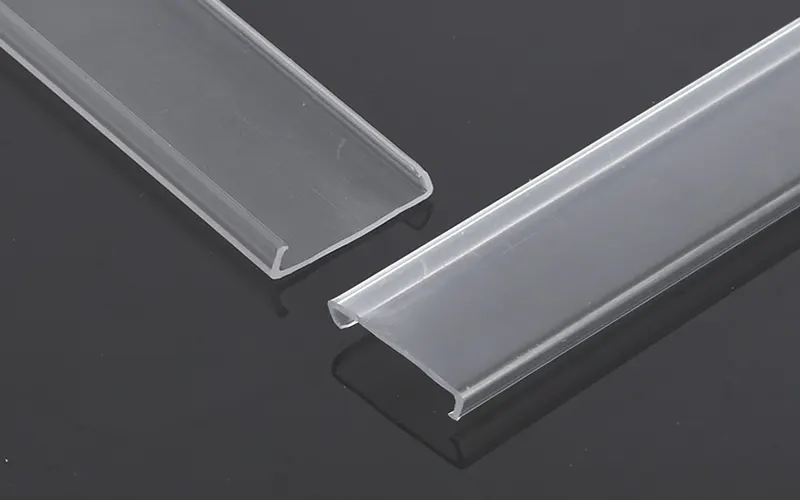
A diffuser is a lens that snaps over an LED strip and serves as a component of the product assembly. It can completely transform the visual effect of the light. There are three main options, along with a few specialized styles.
Transparent Cover Diffuser
This is essentially a rigid, transparent plastic cover (typically made of polycarbonate or acrylic). It allows individual LED chips to be clearly visible, creating a “dotted” or “sequin-like” visual effect on the surface of the profile.
However, this characteristic also presents a downside: glare. The light from the exposed LEDs is harsh and can easily cause visual discomfort.
Suitable Applications: Spaces aiming for an industrial aesthetic or a retro-tech vibe where the light source itself is meant to be visible (e.g., music studios, tech startup offices, or workshops).
Frosted Cover Diffuser
The frosted diffuser cover is one of the most popular choices. Its surface features a micro-texture that effectively scatters light.
It produces a continuous, seamless band of soft light, free from visible hotspots or individual LED dots. It offers the aesthetic appeal of a neon tube while retaining the energy efficiency of LEDs. However, light output is slightly lower (with a luminous flux loss of approximately 10–15% compared to a clear cover).
Suitable for kitchens, living rooms, bedrooms, and offices, it provides comfortable, glare-free illumination—making it ideal for spaces where the light fixture might be directly within the line of sight.
Black Diffuser Cover
A specialized accessory featuring a black, elongated profile with fine horizontal slits. It creates deep, highly dramatic shadow effects. Light is projected sideways, yet when viewed from above, the fixture itself appears “off” or dark.
Black LED profile covers are primarily used in home theaters, high-end retail spaces, or accent lighting areas where upward light spill must be eliminated.
However, note that black covers result in significant light loss (up to 40%). Their use is recommended only when a specific aesthetic style is the primary objective.
Accessories and Installation Requirements for Suspended LED Profiles
The performance of suspended profiles depends largely on the installation method. Unlike snap-in mounts, these require steel cable accessories to secure them to the ceiling.
Steel Cable Suspension Kit
Slender, nearly invisible stainless steel cables (typically 1 mm or 1.5 mm in diameter) are attached to both ends of the profile; they are secured to the ceiling via small discs or claw-style hooks and then tensioned.
We typically supply two sets of these stainless steel cables per meter, though this can be adjusted based on specific customer requirements.
- Pros: Minimalist appearance and flexible adjustability (suspension height can be easily modified).
- Cons: The cables may sway if bumped, so a secure ceiling mounting point is required (use toggle bolts for drywall, or mount directly to the joists or concrete).
Rigid Rod Suspension System (Threaded Rod)
Uses a solid metal rod (typically with a brass, chrome-plated, or black finish) to connect the ceiling to the profile.
- Pros: The mounting hardware has a distinct industrial style and is extremely stable (no wobbling). It is ideal for high-traffic areas.
- Cons: Height adjustment is difficult after installation—readjustment is virtually impossible. Any change in position requires precise re-drilling.
Surface-Mount End Caps
This is another method for installing suspended LED profiles, although, strictly speaking, it does not fall under the category of standard “suspension” mounting.
However, by using surface-mount end caps, you can attach the profile directly to a ceiling junction box, allowing it to hang vertically downward from that point.
- Pros: Neat and aesthetically pleasing electrical integration (cables are concealed within the suspension rod).
- Cons: Limited to vertical suspension; note that the profile does not allow for horizontal angle adjustments.
Conclusion
When selecting the right suspended LED aluminum profile, there are four key factors to consider: shape, dimensions, the diffuser, and mounting accessories.
Overlooking any of these elements can lead to issues—such as a beautifully designed fixture failing due to overheating within just six months, or a frosted diffuser failing to adequately mask the LED chips, resulting in unsightly hotspots.
We invite you to browse our full range of high-quality aluminum profiles today. We also offer compatible suspension cables and rigid rods. Click here to shop for suspended LED aluminum profiles and get a free quote for custom cutting.
FAQs
Yes, we offer customization options, including length and dimensions, surface finishes (anodized, powder-coated, etc.), and the type, shape, and design of the diffuser.
Yes. While our standard lengths range from 1 to 3 meters, we support custom sizing. Users can also cut them to size themselves. After cutting the aluminum, use sharp shears or a fine-toothed saw to trim the PC diffuser to match the length. Be sure to deburr the edges to ensure a perfect fit with the end caps.
The aluminum profile itself serves merely as a housing and does not affect dimming capabilities. Dimming depends primarily on whether the LED light source (strip) supports it. If you use a driver compatible with DALI, 0-10V, or TRIAC dimming, your suspended linear light can achieve full dimming functionality.
Yes, but voltage drop must be taken into account. Intermediate power injection points are required to supply power to the LED strips. Ideally, 12V LED strips should not exceed 5 meters in length, whereas 24V strips can extend up to 10–12 meters.
This is usually caused by one of the following factors: insufficient profile depth—the diffuser is too close to the LED chips.
Low LED density—it is recommended to use LED strips with at least 120 LEDs per meter (12V) or 240 LEDs per meter (24V).
Poor diffuser quality—low-cost diffusers often have a thin frosted layer; it is recommended to choose a diffuser with a thickness of at least 1.5 mm.